This Complete Ethical Hacking Course course on LearnVern is completely free. It will provide a comprehensive understanding of the topic and its practical applications.
This Complete Ethical Hacking Course course on LearnVern is completely free. It will provide a comprehensive understanding of the topic and its practical applications.
Setting up a Hacking Lab using Kali Linux - Part 1
Setting up a Hacking Lab using Kali Linux - Part 2
Setting up a Hacking Lab using Metasploit
Basic Linux commands in Linux
File commands in Linux
Folder commands in Linux
Shell commands in Linux
Linux Directories
Assignment : Introduction to Ethical Hacking
Ethical Hacking Phases
Key Terminologies in Ethical Hacking
Overview of Vulnerabilities
Phases of Ethical Hacking
Introduction to Footprinting
Eavesdropping Attack
Overview of Nmap
Nmap Scanning Methods - Part 1
Nmap Scanning Methods - Part 2
Assignment : Ethical Hacking Phases
Hacking and IP Addresses
Internet Assigned Numbers Authority
Introduction to IP Addressing
IPv4 Addresses
IPv6 Addresses
IP Address Detection
Ping Requests and Ping Sweep
Traceroute
Common Nmap Commands - Part 1
Common Nmap Commands - Part 2
ARP Spoofing Overview
ARP Spoofing Demo
IP Spoofing Overview
IP Spoofing Demo
MAC Flooding
DNS Enumeration - 1
DNS Enumeration - 2
VLAN Hopping Part - 1
VLAN Hopping Part - 2
Countermeasures against Network Securities Attack
Assignment : Hacking and IP Addresses
Hacking and Ports
Introduction to Routing Terminologies
Ports - I
Ports - II
Virtual Port Numbers
Port Scanning
Port Scanning with Zenmap Part -1
Port Scanning with Zenmap Part -2
Advanced Port Scanner
Countermeasures to Prevent Port Scanning
Wireshark Part 1
Wireshark Part 2
Assignment : Hacking and Ports
Hacking and Domain Name Servers
Domain Name Servers
Top Level Domain
Second Level Domain
Domain Name Server Record
Domain Name Server Request
Domain Registration Process - Part 1
Domain Registration Process - Part 2
Generic Top Level Domain Lifecycle
DHCP Starvation Attack
Data Tapping
Assignment : Hacking and Domain Name Servers
Anonymous Browsing and Stegeganography
Introduction to User Identification
Identity Attacks
Anonymous Browsing
Virtual Private Networks
Types of Virtual Private Networks
Virtual Private Network Protocols
IP Proxy
Proxy Bouncing
Add-ons for Web Browsers
TOR Browser
MAC Spoofing
Introduction to Steganography
Steganography Demo
Email Steganography Demo
Audio Steganography Demo
Assignment : Anonymous Browsing and Stegeganography
Hacking and Emails
Basics of Email ID
Email Vulnerabilities Part 1
Email Vulnerabilities Part 2
Email Protocols
Email Spoofing Overview
Email Spoofing Demo
Email Spamming
Email Harvesting
Email Headers
Countermeasures to Prevent Email Hacking
Assignment : Hacking and Emails
Hacking and Malwares
Introduction to Malware
Types of Malware
Introduction to Viruses
Virus Demo
Trojan
Trojan Demo
Keyloggers - I
Keyloggers - II
Creating Bat Files
Countermeasures to Prevent Malware Attacks
Assignment : Hacking and Malwares
Hacking and Password Cracking
Introduction to Password Cracking
Password Cracking Techniques
Dictionary Attacks - BruteForce
Linux Tools for Password Cracking
Countermeasures
Assignment : Hacking and Password Cracking
Hacking and Sniffing
Packet Sniffing - Part 1
Packet Sniffing - Part 2
TCP Dump
Assignment : Hacking and Sniffing
Hacking and Phishing
Introduction to Phishing
Phishing Techniques
How to Create a Phished Page
Phishing Practical - Part 1
Phishing Practical - Part 2
Phishing Practical - Part 3
Reporting Phishing Incidents
Countermeasures
Assignment : Hacking and Phishing
Coding Attacks
Overview
Buffer Overflow
Denial of Service Attack
Distributed Denial of Service Attack
Zero Day Attack
Social Engineering Attack
Honeypot
XSS Exploits Part 1
XSS Exploits Part 2
Salami Attack
Botnet
DOM XSS Exploits
Assignment : Coding Attacks
Website Hacking
Overview of Website Hacking
Google Dorking
Hacking Admin Panel on Websites
SQL Injection Basics Part 1
SQL Injection Basics Part 2
Blind SQL - Part 1
Blind SQL - Part 2
XML Injection
DVWA with Linux
DVWA with Windows
Server Side Request Forgery
Website Exploits
Malware Analysis
Hacking Websites with Burp - 1
Hacking Websites with Burp - 2
Session Fixation Attack
CSRF Attack
CAPTCHA Exploits
Bypassing Cross Origin Resource Sharing - 1
Bypassing Cross Origin Resource Sharing - 2
Heartbleed Attack
XML Attack
File Upload Attacks
Assignment : Website Hacking
Mobile Hacking
Hacking Mobile Devices
Android Web View Exploits
OWASP Vulnerabilities
Windows Hacking
Assignment : Mobile Hacking
Reporting Cyber Crimes
Introduction to Cyber Crime
The 419 Scam
Assignment : Reporting Cyber Crimes
Cyber Laws
Introduction to Cyber Laws
Cyber laws
Cyber Crime Portals Part 1
Cyber Crime Portals Part 2
Cyber Crime Portals Part 3
Chain of Custody
Incident Response-1
Incident Response-2
ITA 2000 and 2008
Trademark Infringement
Copyright Infringement
Indian Regulators for Cyber Security
Central Act and State Act
Assignment : Cyber Laws
Course Summary
Course Summary
Interview Questions
Interview Questions
Career Guidelines
Career Guideline
Course Offerings
Certificate you will get
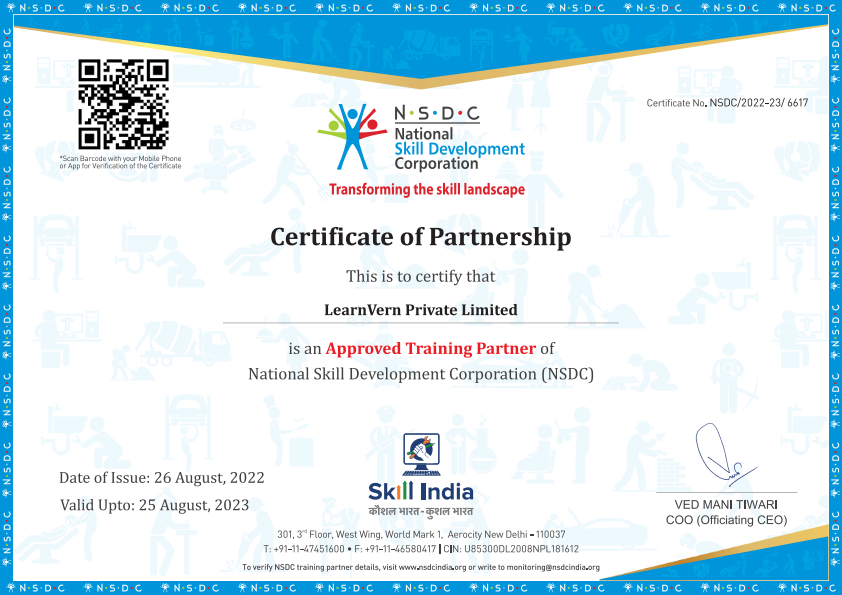
NSDC Certificate of Partnership with LearnVern.
Help build strong resume.
Great add-on to get Internship.
Upgrade your Job with this certificate proof.
Pre Requsites
Basic proficiency in reading and writing.
Familiarity with using technology for research and assignments.
A curious mind and willingness to participate actively.
Course is for
Freshers
Professionals
Students
FAQ's
How LearnVern’s course teaches Ethical Hacking?
LearnVern’s Ethical Hacking course covers basic to advanced topics in Ethical Hacking and Cyber Security. This course is designed to meet the requirements of IT professionals who want to grab better opportunities in Information Security systems.
Who can join LearnVern’s Ethical Hacking course in Hindi?
LearnVern’s Ethical Hacking course in Hindi is tailor-made to the requirements of IT undergraduates, and other professionals. Those who want to learn how to secure websites and applications from hacking can benefit from this course. In addition, information security professionals striving to enrich their skill-set can also easily gain practical knowledge.
What are the unique features of the LearnVern Ethical Hacking course?
LearnVern’s course teaches what is Ethical Hacking in Hindi. It is done to encourage more students not comfortable with English-based training programs. The course allows learners to acquire practical skills in Ethical Hacking and master related processes and concepts. It is available on iOS and Android devices and can be cast on the TV screen too. The course makes the students eligible for the National Skill Development Certificate, a stamp of better credibility.
Can I do an Ethical Hacking course from LearnVern without leaving my current job?
LearnVern allows you to do Ethical Hacking and other courses at a leisurely pace. You need not leave your current occupation and access the course on devices through the application and website as per your schedule. It does not demand you to leave your city or join any college as the course reaches you on your device. The self-paced design of this course makes it suitable for all working professionals.
Which jobs can I apply for after I learn Ethical Hacking from scratch?
Join the LearnVern Ethical Hacking course online for free if you have an interest in cyber-security. The course earns you the eligibility for very high salaried jobs like Cyber Security Architect, Ethical Hacking Trainer, Information Security Analyst, Penetration Testing expert, IT Security Analyst, Ethical Hacker, etc.
What educational qualifications are required to do the Ethical Hacking course from LearnVern?
Graduation in IT is desirable for doing the Ethical Hacking course. Those professionals who are well-versed with the basics of Ethical Hacking and hardware networking concepts can find this course suitable for enriching their skill-set.
What is the fee for joining the Ethical Hacking course at LearnVern?
LearnVern does not charge any fee for joining the Ethical Hacking course. It comes free of cost for all aspirants. They need to have a mobile device or computer and a stable internet connection to access the tutorial and downloadable study material.
Is Ethical Hacking legal? What is it used for?
Ethical hacking is legal and is a tool used for ascertaining the robustness of websites and applications against cyber-attacks. The learners can grasp concepts like IT security architecture and do penetration testing, etc., by doing courses on Ethical Hacking. With the help of Ethical Hacking, companies can understand how to plug all security loopholes. Also, they can understand if the security solutions applied are up to the mark or not.